
☞ ACTA: Support The Wellington Declaration

  • I signed the Wellington Declaration on the Anti-Counterfeiting Trade Agreement and I think you should consider doing so too. Sign today and you can be included in the copy presented to the ACTA negotiators on Tuesday 13th April in New Zealand.

✍ Geeks Vote Too – Use The Logo!

Geeks Vote Too logo

Geeks Vote Too

As the election in the UK approaches, I think it’s time to tell the people chasing our votes that actually we do understand the issues around digital liberty and we think it’s time for them to listen to us as well as the lobbyists. After all, we have votes and the lobbyists don’t.

I’ve designed the simple logo you see to the left. It’s meant to capture the idea that I’m a geek with a vote. During the election season, I intend to wear a badge with this logo, or at some events a t-shirt. I’d be delighted if other people did the same, and/or used the image online.
Continue reading

☞ Happy Birthday Copyright – you need to reform

  • This weekend is the 300th anniversary of the Statute of Anne, the first copyright law. As a wag on Twitter noted, we can’t sing it happy birthday because copyright law today prevents us. The essays on the site linked above are from a diverse set of authors, and make interesting reading. Behind almost all of them is the premise that copyright doesn’t work any more. I agree with this.

    Copyright was never meant to apply to things you and I do; it was a law made in the context of the end of general censorship and the rise of the printing press. It was intended to protect the weak from the powerful and the powerful from each other.  It never applied to people who read printed works, only to those who printed them.

    We’ve seen the immense harm that’s resulted from the semantic sleight-of-hand that justifies the violation of our rights because the phrases “war on drugs” and  “war on terror” includes the word “war”.  A similar, more cunning sleight-of-mind observes that every enjoyment of a work in the digital age requires a “copy”.  That means copyright law applies, and thus a license is required by the consumer to waive the monopoly which copyright grants. The freedoms around created works that the Statute of Anne was actually supposed to protect have thus become an excuse to require licenses for every form of modern enjoyment,  imposed upon the very citizens who should expect to have their freedoms protected.

    The contract expressed by the Statute of Anne (and then made concrete in its echo in the US Constitution) was supposed to be between the powerful producers and society; instead it has become an excuse for the imposition of abusive licenses by the middle-men on the individual – and without fair compensation to the vast majority of authors and other creators. Too many people believe copyright is about the way works are enjoyed, and that belief has led to a self-perpetuating spiral into the abyss of control. Radical reform is overdue.

    Radical means “from the roots upwards”. My repeated call is for copyright to be re-interpreted for the connected era. Like Lessig, I think eliminating copyright is too extreme. The social contract upon which it is based – the exchange of temporary monopoly among distributors for protection of both the creator and ultimate enjoyer of the work – remains valid. But it needs casting in an age where every citizen is a peer, rather than in an age of controlling hubs and passive spokes.

    In the UK, the election is upon us, and the outrage of the Digital Economy Act is fresh in our minds. Let’s get this reform rolling.

Other links: Continue reading

✍ Calling IBM To Account Is Not Judging

I’ve had some useful communications from a variety of well-informed people after yesterday’s blog about IBM and TurboHercules, and two things are clear from what I’ve heard:

  • The case IBM has against TurboHercules has many murky layers and it’s pretty pointless trying to decide from the outside who is right. Certainly the sources we’ve heard so far are insufficient and have unclear motivations, especially knowing that Microsoft’s puppy CCIA is involved. I am not in any way interested in calling either IBM or TurboHercules evil on the evidence so far. To be clear: I have no view on the merits of the actual issue between IBM and TurboHercules.
  • IBM’s actions in the case lack the necessary internal oversight for some reason. IBM messed up in allowing a document to leave the building suggesting any of the patents they had pledged to protect open source software would be used against it, and they need to admit the error and apologise. We all make mistakes, and when we make them most of us are called to account. I see no reason why IBM should be exempt. Continue reading

✍ When Reptiles Attack: Has IBM Tired Of FOSS?

Blue LizardWhat is the significance of IBM’s patent attack on the company behind the open source Hercules community? I believe it may indicate a change in the balance of power inside IBM, one probably reflected in other large corporations, as cloud computing rises in prominence and as the main disruptive force becomes Google – a large user of FOSS – instead of Microsoft. We need to take note. Oh, and I’m using “reptile” in a technical sense 🙂 Continue reading

☞ The Digital Election

  • Kevin Marks with a great (and short) comment that highlights the real, long-term issue with where copyright, trademark and especially patent law is headed. All three were originally intended to prevent abuse by originators of products. All three have become instruments to control consumers of products in the digital realm.

    Until now, those of us with first-hand contact with the emerging digital economy have gone largely unheard as the giants of 20th century industry have used the influence granted to them in the years since they were the underdog to manipulate legislation into shoring up their businesses. Today, legislation acts against citizens rather than protecting them. It’s time to reverse the trend and be heard. I called my MP about the Bill, and I am not alone.

    This election in the UK, we need to put the real digital economy – the one with citizens in it – on the agenda.

Shorter comments:

  • “As copyright laws get more ridiculous, we’re teaching people to not move forward if they don’t know for sure — and that can create a massive stifling of creativity and expression.” — This is the reason we need to turn back the trend expressed by the Digital Economy Bill. As Kevin Marks suggests, it’s creating a digital economy the same way the Locomotive Bill created a transportation system.
  • This is an excellent idea, and I think helping Norbert get the letter tidied up is a worthwhile activity.
  • Presumably after this the trolls with the patent pursue pretty much everyone else on the internet? It’s hard to imagine a better poster-child for patent reform.
  • “Quick, define irony: the BBC, one of the main proponents of a bill to allow them to use other people’s images in ways they didn’t envisage without permission or payment, is furious that somebody has taken a BBC image and used it in a way the BBC didn’t envisage without permission or payment.” — Section 43 of the Digital Economy Bill is a travesty of justice for photographers, from amateurs-on-iStockPhoto like me all the way up.

✍ Copying Is Not Theft; Saying It Is IS Spin

Just in case you were in any way confused (which it seems a whole lot of people are), copying is not stealing, as this charming little jingle illustrates. Infringing someone’s copyright may be against the law, but it is not theft, and whenever you hear someone say that it is you’ve just spotted the “genetic marker” for someone who is either confused or trying to feed you spin. Most likely the latter at the moment.

☞ Time Running Out

Tomorrow is the second reading of the Digital Economy Bill in the House of Commons in the UK. It’s important that we all let our representatives know that geeks vote too and that the people with a first-hand understanding of the issues think it needs more scrutiny. I’ve included three great, thoughtful posts from JP Rangaswami of BT which provide explanations that are good for non-specialists.

  • “We have two more days to mobilise online opposition to the Digital Economy Bill. Here’s what you can do.”

  • JP has written here a long article about the potential unintended consequences of the Digital Economy Bill for the music industry. I disagree slightly with his continued focus on the downloads aspect. The biggest problems with the bill are that, in the name of protecting Cliff Richard’s pension, it will remove photographers’ rights, eliminate open wifi, enable easy censorship for unethical corporations and introduce other abuses the way the DMCA did.

    His analysis is still very much worth reading to bring home the fact that the Bill dabbles inexpertly in an incredibly complex area of interlocking ecosystems and will upset them just as surely as introducing cane toads did in Australia.

  • JP with a delicious parable explaining why the Digital Economy Bill, although well-intentioned, acts in a way that’s disproportionate. Personally I am amazed to hear Gordon Brown preaching about the need for every citizen to have internet access and the need for online access to government services, and then in the next breath saying it’s fine to have it taken away for an offence whose analogue equivalents wouldn’t result in suspension of access to government services.

  • JP illustrates nicely the disconnect between what our politicians think the digital economy is from their (at best) second-hand pedestal and what people actually engaged first-hand in the digital economy think it is.

  • I have so far seen no mention of the challenges of the surveillance society by any political party in the materials delivered to my home.

    While the front benches of the main parties try (hopefully unwittingly) to criminalise kids over copyright, rob photographers of their income, shut down nationwide wifi and provide a way for corporations to censor citizens and competitors, the police are running roughshod over our rights using exactly the same technologies.

    The Digital Economy that our politicians have in mind is second-hand, relayed to them via lobbyists. Today is the day to contact your MP and the candidates in the upcoming election and tell them that you, a first-hand participant in the Digital Economy, are not satisfied.

☞ It Can Get Worse

  • Yes, another posting from me about the Digital Economy Bill. As I keep saying, this bill is about more than just disconnection. Clause 43 sounds fair enough – putting “orphan works” where the copyright owner can’t be found into the public domain sounds a good thing. But it has been badly constructed, presumably with input from lobbyists with skewed interests.

    It will have the side effect of making all photographs public domain unless they are painfully obviously marked with the photographer’s identity. When you write to your MP, ignore disconnection (it will just make them toss your letter); complain about clause 43, about the threat to open WiFi and about the apparently corrupt avoidance of democratic process. Oh, and write today, we’re running out of time.

    And sadly this is not an April Fools prank.

In other news:

✍ Digital Liberty Activism

Ubuntu UK Podcast LogoA big hello to listeners to the Ubuntu UK Podcast, where I’m appearing as a guest on this week’s show.

In my interview in this episode, I focused on digital liberty issues, which I believe to be hugely important and becoming more so every day. If you’re ready to find out more about the issues I discussed, here’s a quick guide along with hints on taking action. I mentioned writing to your MP and MEP – there’s an encouraging guide to read if the idea makes you nervous.

BBC DRM

Driven no doubt by ‘input’ from their suppliers, the BBC have requested permission from the regulator OfCOM to be allowed to add digital restriction measures to their digital TV broadcasts. Many groups – including OSI – are concerned about this. OfCOM are seeking input on how to respond to this request. If you are a UK license-fee payer, you should write to OfCOM today and tell them how you feel about this. The Open Rights Group have everything you need to get started.

Digital Economy Bill

The Digital Economy Bill (or “#debill” to the Twittering classes) is a legislative pastiche covering a wide range of issues. There’s no doubt that the issues it addresses are important to British citizens. But the Bill seems to have been very heavily influenced (albeit with care) by lobbyists from media industries and lacks adequate protections for the rest of us.

It has been framed along the lines of “stop pirate downloaders robbing Cliff Richard of his pension” but it contains many badly considered measures that will affect our digital liberty. Worse, there has not been time spent in Parliament considering this problem. Worst of all, the Bill looks certain to be waved though on a nod and a wink following an inadequate second reading on April 6th in a big rush to avoid the election.

So what can you do?

ACTA

ACTA is the so-called Anti-Counterfeiting Trade Agreement (although it covers far, far more than just the creation of counterfeit goods). This is a big topic I’ve written about here a few times. The best primer on ACTA is probably the Wikipedia page. My illustration about fungus came from a blog post of mine a while back, and you’ll like the LQN summary and the blog by Michael Geist I mentioned.

To take action, start with the action summary I suggested after my visit to FLOSS Weekly.

UK Elections
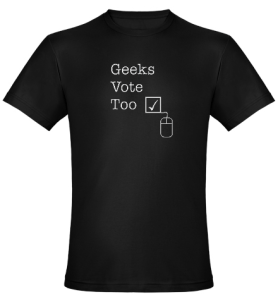
Geeks Vote Too ShirtAs political issues become more and more technology-dependent, it’s important that we ask out political representatives to get educated and pay personal attention rather than just listening to lobbyists. They are, after all, supposed to be representing us human citizens and not the interests of abstract legal-fiction corporations. Both DeBill and the surveillance society in the UK come from listening to to too many lobbyists and not enough voters. They need to know that geeks vote too.

What can you do?

  • Why not join in with the Vote Geek community? There’s no better way to focus attention on digital democracy than to ask informed questions about it.
  • Upload election leaflets at The Straight Choice to help create transparency over election tactics.

Thanks for listening and for visiting my web site – why not subscribe and follow me on twitter?  🙂