☆ ORGCon, London

I spent the day yesterday at ORGCon with friends old and new, enjoying talks from a wide range of speakers including of course Cory Doctorow and Lawrence Lessig. There was a film crew recording all the talks; I’ll highlight some of them here over the next week or so. My tweets about the event might interest you too.

I’m also co-maintaining ORG’s page on Google+, which you’ll find has a steady stream of interesting links – well worth adding to a circle if you’re a G+ user.

If you wish you’d been able to go but couldn’t, you may be interested in another event ORG is arranging in London on April 3rd. Author Bill Patry will be discussing the ideas covered by his new book How To Fix Copyrighttickets are free to ORG members and a very reasonable £7.50 for others.

☆ Not So Shire

The Hobbit is one of our local pubs. It’s a rather seedy student-focussed music venue that serves cheap booze under fanciful names taken from Tolkien’s books. Their web site had (now removed from the pages but still on-site) of publicity material derived from the Lord of the Rings movie stills. I had always wondered how they managed to license the copyrights and trademarks from their owners and now we know the answer.  They didn’t.  And the Nazgûl have come home to roost.
This turns out to be quite an interesting case. In terms of trademark law for the name and copyright law for the recycled movie stills, I’ve little doubt the pub are in the wrong and have had this coming for a long time (possibly so long that if they went to court they might make a case that the trademarks have been abandoned…)  But in terms of popular culture, there’s an arguable case that Tolkien’s work now forms a cultural bedrock in the UK that should allow the names and ideas it has popularised to be used freely.

This is one of the areas I think we have a problem with current copyright and trademark law. It’s all framed by short-term thinking where every motive is a business motive of comparable scale and intent. It has no trapdoor for modern cultural artefacts – the songs that have entered the national psyche, the stories that have become every child’s nursery, the images that wallpaper everyone’s memory – to be released from the dragon’s grip and mutate from wealth artefact into cultural jewel.

Worse, the trend is in the opposite direction – longer monopolies, more draconian punishments for violating them (even unknowingly), the permanent annexation of popular culture by the companies lucky enough to have got away with stealing it before the law got this way. The idea of these ‘intellectual monopolies’ being a temporary gift to further the public good is all but lost, especially in the minds of the companies getting rich from them.

So while I don’t think the pub has a chance, I do think it’s worth highlighting the case in public. Sometimes the public good is served by the end of monopolies rather than by their continuation. As a friend said, can you imagine how Britain would be if Shakespeare’s estate still controlled all his works?


[Updated March 16:  They’ve removed the loyalty card images from the web site, probably as part of the settlement they have been offered. From the tone of their statement I don’t think they really understand, though, and the poster artwork is still there]

☝ OIN’s New Linux Definition Excludes Consumer Devices

Are you safer from software patents today, or more at risk? The news that the Open Invention Network (OIN) has extended the definition of “Linux” so that more software is covered by its patent pool is good news, no question. But the new definition also includes carve-outs that put all Linux developers on notice that Phillips and Sony reserve the right to sue over virtualization, search, user interfaces and more – including Android, which is conspicuously absent from the list. Seems consumer devices powered by Linux are in the cross-hairs. Read about it in my column today on InfoWorld.

☆ Hollow Point

Each time I am told I should unreservedly respect decisions made by authorities in secret, I remember this song by Chris Wood. I always cry when I play it.

[youtube http://youtu.be/tI2YdHt_V7s]

In case you don’t recognise the story, it’s about Jean Charles de Menezes and his killing by British police whose certainty he was an Islamic terrorist overcame their humanity.

Folk music is still our folk memory. Bad laws limiting criticism of official business, restricting mention of trademark terms or preventing adaptation of popular culture will kill it and make us forget.

☆ Is Windows to blame for viruses?

Bug engaged in exploitA historical post, for a change. A comment on a mailing list tonight – that something was “rather like blaming Windows for getting viruses” –  sent me exploring my recollections of CPU security on Intel chips from my days at IBM. I went scurrying to find a half-remembered explanation from the past of why, in addition to the larger user base making the target much more tempting, Windows has suffered from virus attacks much more than anyone else to date. I couldn’t find it straight away so this post is the result.

Before you add a comment, note I am NOT saying that the only explanation for Windows viruses is this technical one; obviously the huge attack surface of the giant user base attracts attackers. I AM saying, however, that leaving the door open for a decade hasn’t helped and is a major reason why the dominant form of malware on Windows is the virus and not the trojan.

Exploitation

All operating systems have bugs, and I suspect (although haven’t found any data tonight to confirm) that they occur at approximately the same frequency in all mature released operating systems. All operating systems that respect Shaw’s Law are also vulnerable to malware. Malware depends on identifying exploits – defects of some sort in system security that can be “exploited” to permit infestation by the malware.

Not all bugs turn into security exploits, though. In particular, in Unix-like operating systems like OS X, Linux and Solaris, it’s unusual for bugs to lead directly to security exploits; instead, most malware depends on user error or social engineering.  For an exploit to exist, there has to be a way to use knowledge of the bug to gain access to a resource that would otherwise be forbidden.  It certainly happens on *ix systems, but the operating system has checks in place to prevent the most common way of turning bugs into exploits.

Unauthorised Pokes

The most common way for this to happen (although there are many others) is for the operating system to fail to differentiate between data and program code. By treating code and data  as the same thing, a path is opened for malware to use a bug to push some data into a memory location (a “buffer over-run” or a “stack overflow” are examples of this) and then tell the computer to execute it. Hey presto – exploit. All an attacker has to do is push code for a virus (or a virus bootstrap) into memory and ask for it to be executed, and your computer is compromised.

Windows could have prevented this sort of thing from happening by exploiting ring protection offered by Intel x86 architecture from the 80186 chip onwards. A feature of Intel’s x86 architecture makes it possible to prohibit execution of data unless the program in question is privileged (“at ring 0”), usually by being part of the operating system. Application code at ring 3 can be forbidden from executing data.

Indeed, Windows did use ring 0/ring 3 differentiation for some jobs (skipping rings 1 and 2 for cross-platform technical reasons). But access to ring 0 – “able to execute anything you want” – was never prohibited. Doing so would have prevented legacy DOS code from running, so as I remember being told, Microsoft chose not to implement ring 0/ring 3 protection in Windows NT until it was completely sure that deprecating DOS legacy support would no longer be a marketing issue. That was in Windows 8…

Credit Where Due

So actually it’s somewhat appropriate to blame Windows versions prior to Windows 8 for being vulnerable to many viruses which exploited bugs in this way. The existence of the vulnerability was a conscious choice and a marketing decision; in OS/2, which had no legacy to accommodate, the ring 0 separation was enforced.

Yes, Windows also offers a larger attack “surface” because of its wide adoption, and yes, there are other exploit mechanisms. But this tolerated technical vulnerability is the root cause of a large number of exploits. So while it’s true that malware authors are directly to blame for malware, there’s also a culpability for Microsoft that can’t be ignored. Thank goodness Windows 8 has addressed this particular issue.

☆ IPEG-SA Announces Tapeworm Licensing

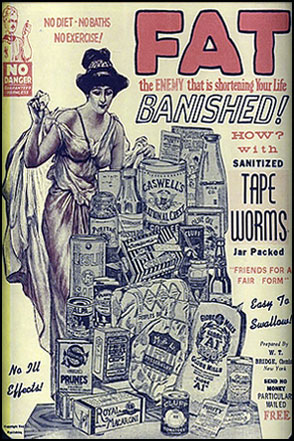
Tapeworm AdvertFollowing news that MPEG-LA have generously offered to sell patent licenses to implementers of the latest 3D-capable video standard, MVC, the world’s tapeworms announced they have formed a new collective inspired by the same principle.

Dubbed IPEG-SA (Intestinal Parasites Exploitation Group – Service Administration), they will offer humans the opportunity to license suitably sanitized tapeworms for a small fee. Charging only 10 cents per meal per worm, a representative said this was “an unparalleled opportunity to be assured that future infestations of the digestive system will be sanitary.”

The representative went on to explain the scheme in greater detail. “While humans may face risks from unlicensed infestations, sanitized tapeworms of the kind administered by IPEG-SA have acknowledged health benefits, especially for the control of obesity”, said the spokesworm. “We have been preparing this initiative ever since MPEG-LA announced they intended to offer licenses to implementers of the open WebM video format. We were impressed that, even though they had no hard evidence of any need for a license, they still went ahead and offered one. What inspiring innovation!”

IPEG-SA admitted they could not offer any assurance against other infestations, but noted that their fees – around $2 per week if snacks are avoided – offer tremendous value and were in no way “a tax on living” as some detractors claim.

☝ Eolas Verdict A Hollow Victory

With news breaking that apparently Eolas decade-plus attempt to tax innovation on the internet is finally over, I look at the context and find myself lacking reassurance in today’s column on ComputerWorldUK.

☆ How To Fight ACTA

Now that the US bills SOPA and PIPA have been put on ice, attention has returned to their parent, an international treaty called ACTA. I’ve written extensively about ACTA before, but in summary it is an international treaty that has been secretly negotiated to ensure as little input as possible from the citizens of any country.

While superficially about stemming the flow of counterfeit physical goods (ACTA stands for “Anti-Counterfeiting Trade Agreement“), the copyright and patent industries (music, movies, software, pharmaceuticals and more) have successfully infested it and the result is a trade agreement that substantially reduces the scope for discretion over new approaches to business on the internet.

While we are told ACTA “will not require changes to Europe’s laws”, it creates an environment where we can expect all the most controlling and invasive parts of every country’s laws to be emphasised and all the most flexible parts – such as fair use, the public commons and cultural expression – to be minimised. It’s a treaty that will be cited every time the USA wants to extradite a British citizen over copyright, for example – even when no law in Europe is being broken. Like DRM, ACTA quantises discretion and reduces all our freedoms.

Despite the fact it is obviously controversial – even the MEP tasked with working on it for the European Parliament quit – the European Commission saw fit to co-ordinate its signing by most European administrations last week. They are now ridiculing opposition to their actions and misrepresenting the impact of ACTA.  A clear gesture of defiance to the popular will expressed against SOPA/PIPA, this is anti-democratic arrogance at its worst and a gift to Britain’s euro-sceptics.

Mobilising MEPs

All is not lost, though. ACTA will come to the European Parliament in June for ratification, and there is every chance that MEPs can be mobilised to reject it. Since the treaty has already been finalised in secret and presented to the world as a fait accomplis, rejecting or accepting it whole are the only available options. But since, according to the European Commission, it changes no laws, presumably its rejection is no big loss.

I’m reminded of the battle by the Internet against the Software Patent Directive back in 2005. That too was an unwise legislative direction that would have seriously impacted European business by allowing giant monopolistic international corporations to stifle competition, even for interoperable software permitted by copyright law. MEPs had been told the Directive was a non-controversial piece of industry law that should just be waved through. The European Council waved it through on that basis.

To their surprise, there was a massive backlash from a large number of previously politically silent citizens across Europe, culminating in a huge protest at the European Parliament. MEPs were faced with a public backlash. While the actual mechanism for its defeat was obscure and complicated to explain, the basic reason the Software Patent Directive was defeated was that MEPs discovered they had been deceived and that the topic was in fact highly controversial and citizen-oriented.

We need to demonstrate the same for ACTA. It’s not a business-as-usual commercial-only matter. It’s a treaty that stifles the soul of the meshed society in the interests of the winners in the technology markets of the twentieth century. In the coming months we all need to speak out.

[First published on ComputerWorldUK]

☆ Patents and Innovation

What Does Not Kill Me Makes Me StrongerAn interview with a pharmaceutical industry analyst on the BBC today illustrated a key point about patents and reminds us they are about stimulating, not rewarding, innovation.

Explaining why AstraZeneca were having difficulties that were making them plan large layoffs, the analyst talked about the “patent cliff”, and the interviewer insightfully observed that it was the motivation to continuing innovation. The “patent cliff” is the end of the 20 year monopoly on an invention. During the 20 years period, the pharmaceutical company has no competition and is free to charge whatever it wants for a drug. It is thus able to make enormous profits.

As soon as the 20 years are up, other drug companies are able to use the knowledge that’s freely available in the commons to produce the drug at a price the market will bear rather than at a monopoly price. The inventor is then able to continue making and selling the drug, but not at monopoly prices. The only way to continue making monopoly profits is to invest in research and to continue to innovate. Thus, the “patent cliff” is actually a spur to innovation and achieves exactly what the social contract behind patents was intended to achieve – a incentive for research and innovation so that the pubic commons is enriched.

In other comments on the news, I could clearly hear people ready to use this news to demand extensions to the patent span for pharmaceuticals. But a key quote from the BBC article contains the real sting in the tail – it’s not the loss of patents that’s to blame as much as a failure to innovate fast enough:

The company is also facing the loss of patents on some of its products such as anti-psychotic treatment Seroquel, and has not yet released alternative money earners.

While the equation clearly depends on the monopoly as a reward for innovation, the spur to innovation is actually the expiry of the patent. While some would have us believe that extending patent terms would increase innovation, there is clearly a balance to be achieved. If patent terms are extended, there’s a real risk of reducing the incentive to innovate. We have to remember that the point of society granting patents and temporary monopolies is not to reward innovation; it is to encourage it.

☝ ACTA’s Back

Are the European Commission just trying to provoke us? Having seen the depth of feeling over SOPA and PIPA, you would expect the European Commission to regard ACTA as a hot topic. But not a bit of it – they almost seem to relish the confrontation by getting member states to sign it almost before the blood was cold in SOPA and PIPA. I believe we need to repeat the experience of the Software Patent Directive, and I explain why on ComputerWorldUK today.