Posted on September 24, 2010 by Simon Phipps
-
It turns out that software publishers really don’t like copyright law alone. It gives their customers far too many rights – in this case “first sale” rights – and they would much rather use contracts that avoid giving any rights similar to ownership.
Doing so allows them to control and manipulate the customer in ways the framers of copyright law never imagined and which negate the social contract – benefit to society in return for a limited monopoly – that is its foundation. The use of copyrights and patents as a lever to force contractual agreements is common and is rapidly eroding both our liberty and our cultural commons. Used with proprietary EULAs it is the antithesis of both software freedom and the Creative Commons.
“The American Library Association and eBay argued against the outcome. The library association said it feared that the software industry’s licensing practices could be adopted by other copyright owners, including book publishers, record labels and movie studios.”
Also:
-
Just in case you thought the article by Glyn Moody that I linked yesterday was a one-off, this techDirt article from earlier in the year alleges that sophistry is a BSA strategy rather than an accident.
-
Just as ForgeRock did recently, The Mozilla Foundation has become a licensee of the Open Invention Network so they can use OIN resources in the event of a patent attack. Note they are clear to point out that, like us, they are not endorsing software patents, just adopting an obvious and free defence against them.
Filed under: Links | Comments Off on ☞ Copyrights or No Rights
Posted on September 23, 2010 by Simon Phipps
-
Glyn’s research here is very useful. The BSA use of statistics is very regrettable, as is their use of inuendo and framing to build the impression that their outlook is correct. They are a vestige of a passing business model and everything they say should be questioned and disbelieved until independently proven.
-
This is a very worrying development. The creation of an ideological firewall for the US, under the essentially unaccountable control of corporate interests, is a huge threat to the future of internet freedom.
-
No mention of the future of the JCP or a plan to unblock the Apache Harmony issue. Instead, an appeal to populism redolent of a plebiscite: “The decisions regarding the features to be included in the JDK 7 and JDK 8 releases were made with active participation of the Java community.”
Filed under: Links | 1 Comment »
Posted on September 16, 2010 by Simon Phipps
My essay on copyright aggregation in open source projects has finally moved to the Essays section of the web site; future updates and edits will happen there.
Filed under: Webmink | Comments Off on ☂ Copyright Aggregation Essay
Posted on September 14, 2010 by Simon Phipps
-
Jon Udell argues that the switch to OAuth comes at the cost of a loss of flexibility and the potential for innovation. Interestingly, he doesn’t mention the other problem – the impact on open source software.
-
Excellent approach to trademark stewardship here. The open-by-rule principle – that a community should be an equal place where every participant has the same rights to the collective copyrights, trademarks and patents as everyone else – seems to be scrupulously observed in the WordPress community and I’m very impressed.
Filed under: Links | Comments Off on ☞ Wise Handling
Posted on September 13, 2010 by Simon Phipps
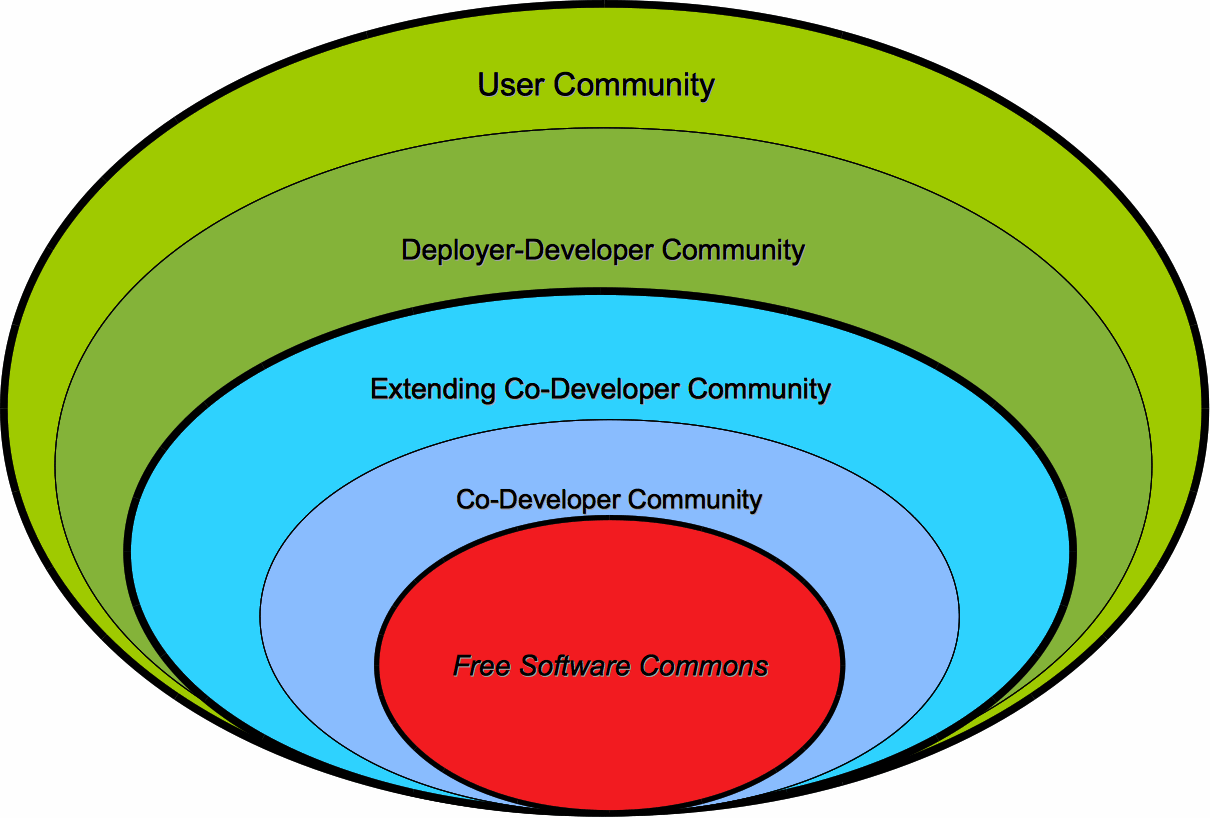
 My essay on Community Types is now available in the Essays section of the site. It defines what I mean by terms like “co-developer” and “deployer-developer” when I use them in conversation.
Filed under: Governance, Webmink | Tagged: Essays | Comments Off on ✍ Community Types Essay
Posted on September 11, 2010 by Simon Phipps
Filed under: Links | Comments Off on ☞ Tidying
Posted on September 10, 2010 by Simon Phipps
-
Fascinating and detailed analysis of the anti-trust complaints against Google. The conspiracy theories Pamela espouses are well-based.
At the start of last year as I was working on other technology policy issues with colleagues in Brussels, there were constant stories of indirectly-but-identifiably Microsoft-sponsored lobbyists and lawyers forming groups to initiate a variety of cases against Google over there, on the premise that “anti-trust has changed us and now Google are the new monopoly”. I heard the same from colleagues in DC too.
So, as Pamela says: “Is this perhaps more abuse of the legal and administrative systems for anticompetitive purposes? If so, could somebody investigate *that*?”
-
“OpenIndiana is part of the Illumos Foundation, and provides a true open source community alternative to Solaris 11 and Solaris 11 Express, with an open development model and full community participation.”
Filed under: Links | 2 Comments »
Posted on September 9, 2010 by Simon Phipps
-
“Google could have avoided all this by building Android on top of IcedTea, a GPL-covered Java implementation based on Sun’s original code, instead of an independent implementation under the Apache License. … It’s sad to see that Google apparently shunned [the GPL’s] protections in order to make proprietary software development easier on Android.”
-
Carlo Piana relays an important message from his Oracle contacts to say that their action against Google is a one-off and not a sign of the commencement of general hostilities. Fascinating how it’s easier for them to do this than speak for themselves.
Filed under: Links | Comments Off on ☞ Will Run And Run
Posted on September 8, 2010 by Simon Phipps
-
If you thought there was something fishy about the European Commission engaging in secret negotiations at ACTA behind the backs of the European Parliament and against the interests of Europe’s digital society, you’d be right. I missed this when it was first posted back in April, but it turns out that the Commission sought permission to negotiate not from a relevant part of the Council of the EU such as trade or competitiveness, but from the Fisheries committee.The whole matter around ACTA – both the negotiations and the mandate of the negotiators – is a disgrace to modern democracy, hidden from scrutiny both of citizens and their elected representatives, with the goal of establishing by fait accomplis a set of precedents that will over-rule the instinctive and correct misgivings that we all have about the creation of legislation to protect broken business models in perpetuity.
-
Yes, all that work many of us across Europe put in to call MEPs and ask them to sign Written Declaration 12 succeeded and at the 11th hour it has become the ratified position of the Parliament.
-
The process to revise the Mozilla Public Licence is well under way – today the team released their “Alpha 2” draft, and invite inspection and comment.
Filed under: Links | Tagged: ACTA | Comments Off on ☞ Transparency: Wrong and Right
Posted on September 7, 2010 by Simon Phipps
-
Good pointer here by Glyn to an action we can take to check the effects of pro-patent lobbying in Europe. He misses a trick when he doesn’t point out that even RF licensing of patents in standards can be toxic to open source.
If the patent holder uses a non-royalty-based restriction – such as the requirement that all legal entities must register for a no-charge license – the lack of a single legal entity to take that action for many open source communities makes it a show-stopper. Worse, if any license so obtained is non-sub-licensable then even the existence of a legal entity would still mean an insurmountable practical barrier existed for the project. Any implicit requirement that the license was necessary would also breach the terms of the license for many projects.
In summary: RF is only of if it means “restriction-free”, not “royalty-free”.
-
Shameful action by the European Commission, who are pressing for patent infringement to be included in the scope of ACTA.
-
If Ruby on Rails is a bit ambitious for you, why not build your next project in Cobol on Cogs?
Filed under: Links | Comments Off on ☞ Governments Protecting Outdated Business Models






 Wild Webmink