☝ A Bright Future For LibreOffice

Following on from my blog post at ComputerWorldUK, InfoWorld in the US asked me if I would write a column for them about LibreOffice. I gathered together the rather large number of positive news releases from the community in February and found a very positive story writing itself. You can find it at InfoWorld Open Sources today.

☝ Why I Want My Pi

The Raspberry Pi reminds me of my youth – it’s a gadget like that which got me interested in technology in the first place. I hope the Pi will tempt today’s generation in a similar direction Read more at ComputerWorldUK.

⚡ Scutter Prototypes

In the humourous cult sci-fi TV series Red Dwarf, which is set aboard a space ship far in the future, the ship is cleaned and maintained by odd-job-robots called Scutters. Watching this demonstration of the aerial robotic equivalent of synchronised swimming makes me think of them.

[youtube http://youtu.be/_sUeGC-8dyk]

On another note: yes, I want one, I even have it on my Amazon wish list!

☆ IPEG-SA Announces Tapeworm Licensing

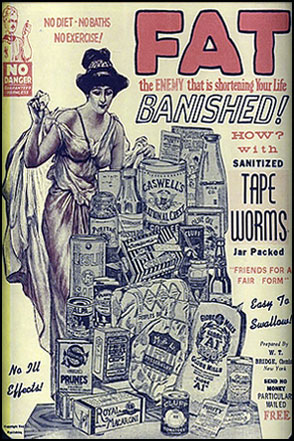
Tapeworm AdvertFollowing news that MPEG-LA have generously offered to sell patent licenses to implementers of the latest 3D-capable video standard, MVC, the world’s tapeworms announced they have formed a new collective inspired by the same principle.

Dubbed IPEG-SA (Intestinal Parasites Exploitation Group – Service Administration), they will offer humans the opportunity to license suitably sanitized tapeworms for a small fee. Charging only 10 cents per meal per worm, a representative said this was “an unparalleled opportunity to be assured that future infestations of the digestive system will be sanitary.”

The representative went on to explain the scheme in greater detail. “While humans may face risks from unlicensed infestations, sanitized tapeworms of the kind administered by IPEG-SA have acknowledged health benefits, especially for the control of obesity”, said the spokesworm. “We have been preparing this initiative ever since MPEG-LA announced they intended to offer licenses to implementers of the open WebM video format. We were impressed that, even though they had no hard evidence of any need for a license, they still went ahead and offered one. What inspiring innovation!”

IPEG-SA admitted they could not offer any assurance against other infestations, but noted that their fees – around $2 per week if snacks are avoided – offer tremendous value and were in no way “a tax on living” as some detractors claim.

☝ LibreOffice Matures

Now finally and firmly established as an independent entity, The Document Foundation and LibreOffice are a refreshing story of community triumphing over adversity. Read more over at ComputerWorldUK.

☝ Eolas Verdict A Hollow Victory

With news breaking that apparently Eolas decade-plus attempt to tax innovation on the internet is finally over, I look at the context and find myself lacking reassurance in today’s column on ComputerWorldUK.

☝ A New OSI For A New Decade

OSI is changing, and you can help!  I spoke at FOSDEM in Brussels on Saturday, on behalf of the Open Source Initiative (OSI) where I serve as a director. My noon keynote covered a little of the rationale behind OSI, a quick synopsis of its last decade and then announcements about the work we’re doing to make OSI strong and relevant for a new decade. Read all about it at ComputerWorldUK or at the OSI web site.

☝ ACTA’s Back

Are the European Commission just trying to provoke us? Having seen the depth of feeling over SOPA and PIPA, you would expect the European Commission to regard ACTA as a hot topic. But not a bit of it – they almost seem to relish the confrontation by getting member states to sign it almost before the blood was cold in SOPA and PIPA. I believe we need to repeat the experience of the Software Patent Directive, and I explain why on ComputerWorldUK today.

☆ Mozilla peut-elle apporter l’unité à l’open-source ?

La nouvelle licence open-source de Mozilla est bien plus qu’un simple ravalement de façade. Elle pourrait créer de nouvelles possibilités pour l’unité de la communauté du Libre.

La première semaine de janvier 2012 marque un jalon discret mais important dans le mouvement de l’open-source, grâce à la publication d’une deuxième version de la Mozilla Public License (MPLv2) et sa validation en tant que licence libre officielle. Quand bien même beaucoup n’y voient qu’un énième détail juridique, cette publication est importante à deux titres : le procédé par lequel on l’a élaborée, et l’objectif pour lequel on l’a créée. Il s’agit d’une licence qui a pour but l’unité.

Rédaction et révision de cette licence se sont déroulées selon un processus très ouvert, dans lequel Luis Villa a joué un rôle prépondérant. Organisé en majeure partie dans des forums publics, le débat a conduit à de nombreuses modifications du texte. Luis est entré en contact très tôt avec l’Open Source Initiative, a accepté les retours du groupe de révision des licences, puis obtenu sans mal l’approbation du conseil d’administration.

D’autres articles sur cette nouvelle licence se sont concentrés sur les modifications de la partie « patent peace » (NdT: la paix des brevets) et autres ajustements des clauses (adieu, Netscape !), mais le changement le plus important apporté par la version 2 de la licence Mozilla est à mon sens l’inclusion d’une compatibilité particulière avec la GPL (GNU General Public License). Par le passé, le projet Mozilla jonglait avec un système complexe et peu clair de triple licence afin de composer avec les univers des licences copyleft et non copyleft. De manière générale, les autres utilisateurs de la MPL (et ses nombreux clones rebaptisés) ne prenaient pas cette peine, et par conséquent certains codebases se sont retrouvés exclus de toute collaboration possible avec l’immense univers des logiciels placés sous licence GPL.

Selon un procédé inédit que la Commission européenne a inauguré pour la licence publique de l’Union européenne (EUPL), la MPLv2 inclut des clauses permettant à un projet de stipuler, de façon optionnelle et explicite, sa compatibilité avec d’autres licences, en particulier celles de la famille GPL. À mes yeux, la MPLv2 représente une mise à jour d’envergure de la famille précédente des v1.x, justement grâce à cette compatibilité explicite avec la GPL, laquelle offre pour la première fois une passerelle praticable entre les paradigmes permissifs et copyleft. Elle ne satisfera pas les puristes des deux mondes, mais propose avec pragmatisme une nouvelle solution aux projets open-source appuyés par des entreprises. Celles-ci pourront disposer d’une communauté qui produit du code sous licence permissive tout en fournissant à cette même communauté un moyen d’entretenir des relations avec d’autres communautés travaillant sur du code sous licence copyleft.

Avec le déclin continu du business model de la double licence (ce que d’aucuns nomment « exceptions commerciales au copyleft »), il devient de plus en plus évident que les licences permissives sont importantes pour les entreprises commerciales qui contribuent à l’open-source. De la même façon, l’écosystème GPL ne disparaîtra pas, aussi les conceptions qui reposent sur une opposition idéologique – y compris celles qui prônent l’élimination de tout code sous GPL – sont néfastes pour toutes les entreprises.
Je salue l’arrivée de la MPLv2, un pas en avant vers l’unification de la cause commune de nombreux développeurs open-source. Bravo, Mozilla !
[Traduction par/Translation by Rico Moro – thanks! The original article was posted to ComputerWorldUK]

☝ Insecurity By Obscurity

I was so shocked by the way Symantec has left its customers to twist in the wind for five years I had to write down some serious questions about their  pcAnywhere advisory this week.  Read them on ComputerWorldUK.