


The why and wherefore of IPv6 Day, as well as plenty of handy links, are over on my blog at ComputerWorldUK.
Filed under: ComputerWorldUK | Comments Off on ☝ Happy IPv6 Day
The why and wherefore of IPv6 Day, as well as plenty of handy links, are over on my blog at ComputerWorldUK.
Filed under: ComputerWorldUK | Comments Off on ☝ Happy IPv6 Day
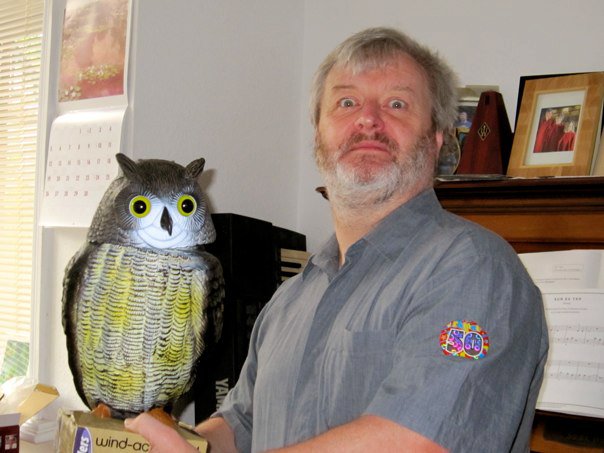 No chickens, and not the peregrine falcon I had hoped for, but the owl I was given for my birthday is splendid and we get on fine. It may even scare the pigeons off the fruit trees.
Filed under: Webmink | 1 Comment »
As the pressure on and from political leaders to “regulate” the internet mounts, the need for basic infrastructure to switch from hierarchical to distributed control is becoming more urgent. The week has seen a number of developments that highlight the growing conflict between those with vested interests in centralised control of the web and those who believe control points are a form of defect. Read about it on ComputerWorldUK.
Filed under: ComputerWorldUK | Comments Off on ☝ eG8, Control Points and NameCoin
Having suspended disbelief for as long as I could, my ability to take Microsoft at their word over Skype was shattered today by the announcement by Digium, sponsors of the Asterisk project, that they have been told they can no longer sell their Asterisk-Skype interaction module after July 26. In one move, we have illustrated the risk of a hybrid open source model, the danger of dependency on a proprietary system, a proof that Microsoft still can’t be trusted with open source and an impetus to open source innovation.
All in one announcement. Read all about it on ComputerWorldUK.
Filed under: ComputerWorldUK | Tagged: Asterisk, Linux, Microsoft, Skype | Comments Off on ☝ A liberating betrayal?
Yesterday I read LWN’s (paywalled but accessible from here) interview with Mark Shuttleworth, where he is quoted as saying that the formation of The Document Foundation (TDF) and its launch of LibreOffice “led Oracle to finally decide to stop OpenOffice development and lay off 100 employees.” Mark says this in the context of his new campaign as an apologist for Contribution Licensing Agreements, about which I have written extensively.
I felt that Mark’s use of OpenOffice.org as an argument in favour of CLAs was jaw-dropping, so I wrote a response on the plane home today. You can read it now behind LWN’s paywall using my special link.
Filed under: Copyright, LibreOffice, LWN | Tagged: Document Foundation, LibreOffice, Mark Shuttleworth | 1 Comment »
Cloud computing is not just disruptive to the software market; it’s also disruptive to software freedom advocacy. Software freedom has been defined as being present when any recipient of a software binary has the freedom to also use the source code for any purpose, study the source code, modify it and distribute it themselves. Cloud applications fail this test at the first hurdle, since no-one is actually receiving a software binary and thus the “four freedoms” analysis to determine the presence of software freedom is inapplicable.
Does this mean no-one should use cloud solutions? While there are some extreme voices that assert abstinence, I think that’s an untenable position. Cloud computing offers so many benefits – many resonant with what people have historically sought from software freedom – that it’s sure to be used. Listening to entrepreneurs and investors here at OSBC, there’s no doubt that the future of software has a substantial dimension in the cloud.
Read the full article over on ComputerWorldUK.
Filed under: ComputerWorldUK | 2 Comments »
As Glyn Moody discussed yesterday, the Business Software Alliance (BSA) annual report on “piracy” is out. I hate that usage – the word “piracy” refers to about the worst crime humanity is able to conceive, involving theft by intimidation, hostage-taking, rape and murder, and it is cynical marketing of the most disgusting kind for the BSA to continue to equate it with the unauthorised use of copyright materials, perhaps under circumstances their own members have created.
On this topic, I’ve taken today’s link post and expanded it on it over on ComputerWorldUK – take a look.
Filed under: ComputerWorldUK, Copyright | 1 Comment »
Some people seem to think Google’s ChromeBook is just a cheap laptop with Linux on it. But I think that’s short-sighted. This is yet another attempt at a network computer. Read about it on ComputerWorldUK.
Filed under: ComputerWorldUK | Tagged: ChromeBook, Google | Comments Off on ☝ ChromeBook, SunRay Reborn?
 I have a firm belief that open source software communities become strong when people with many different reasons for being present are free to meet their needs in a community. If everyone sees the software the same way, it’s very hard for more than one company to participate strongly in the community with the result it tends towards being a user community with few co-developers. As you might guess, I’ve seen a lot of communities like this in my time.
At ForgeRock, it’s our vision to create a secure and scalable platform for building real-world applications on the web, and the I3 platform that we’re gradually creating uses a range of different open source projects to achieve this. But we’re keen to see the technology base we’re using become more modular, so that differently-motivated uses of the components can find synergy without directly competing. To that end, I’m very pleased to be able to make an announcement about a new community we’re sponsoring – OpenICF.
OpenICF is a community that draws together the many users of the Identity Connector Framework, ICF, which makes it straightforward to create connectors for joining applications together to co-operate. We’re using ICF connectors in OpenIDM, but you’ll find that community members – and there are more than the press release lists – are using ICF-based connectors in a variety of contexts, including Brinqa who are using ICF with compliance and risk management solutions .
This diversity is very healthy. It means different people will see the software in different ways, bringing fresh, innovative ideas and introducing the opportunity for serendipity. It’s that characteristic that makes the strongest open source communities. For evolution to succeed, there has to be mutation!
Filed under: ForgeRock | Tagged: OpenICF | 1 Comment »
https://twitter.com/#!/ForgeRock/status/67653156041003008
Filed under: ForgeRock, Tweets | Comments Off on ⚡ One To Follow

Meshed Insights - Open Source Management Consulting

All views expressed on this blog are those of Simon Phipps and do not necessarily reflect the views of any other entity, including current and former employers and clients. See my full disclosure of interests.
© 2010-23, Simon Phipps. All rights reserved, all wrongs righted. Unless otherwise credited all photographs, videos and other media are included in this statement. Some photographs are available for licensing via iStockPhoto. To contact the author, please use the e-mail form.


 Wild Webmink