


If you aren’t following my new travel blog, do give it a try!
Filed under: Global Mink | Comments Off on ✈ New Travel Blog
If you aren’t following my new travel blog, do give it a try!
Filed under: Global Mink | Comments Off on ✈ New Travel Blog
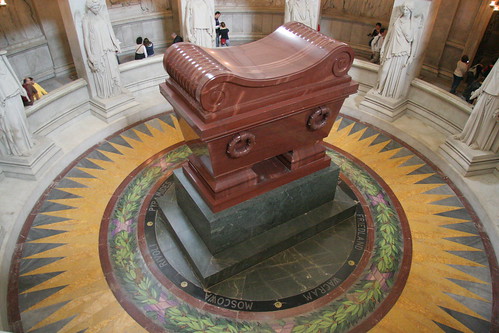
Spending as much time travelling as I do, one of the things that strikes me is how differently we all view history. For example, a favourite perspective vortex is to visit the tomb of Napoleon I in the crypt of Les Invalides in Paris and realise that all the terrible stuff I learned in school about “old Boney” was at best only half the story.
As well as the stuff about ruthlessly dominating Europe by armed force (which, of course, is spun differently in Paris!), the walls of his magnificent tomb at the Les Invalides recount how he created a fair system of law, established education for all, created a national network of roads and so much more. I’m sure French children learn all about this but all English children learn is about wars and how we eventually put Bonaparte in his place (a small, remote island).
View original post 409 more words
Filed under: Links | Comments Off on
Sacred cows are not necessarily a problem. Just because something is sacred, that doesn’t mean it can’t also be useful. Make the most of them.
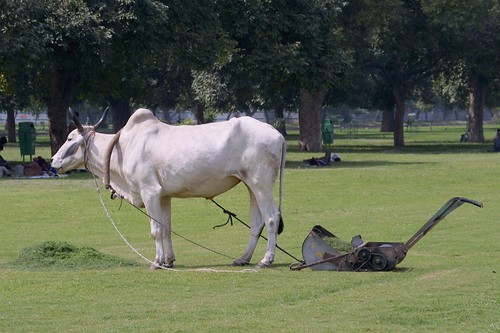
Cows are respected as a symbolic spiritual presence in India. They roam the streets freely and are described as “sacred”.
I took this photograph on the Raj Path in Delhi. One of the gardeners there was using the cow to pull the lawn mower, and rewarding the cow with luscious grass clippings. All very eco-friendly and practical!
Just because something is sacred, that doesn’t mean it can’t also be useful! Make the most of your sacred cows…
Filed under: Global Mink | Comments Off on ✈ Eco Mower
As wave after wave of privacy news arrives, it’s easy to believe that public postings on social media sites are the problem. But I believe we are facing an issue caused not by public sharing but by an encounter with a new kind of “public”. Read my article on ComputerWorldUK today to find out more.
Filed under: ComputerWorldUK | Comments Off on ☝ A New Kind Of “Public”
 Who said this?
“The Church in its own bubble has become, at best the guardian of the value system of the nation’s grandparents, and at worst a den of religious anoraks defined by defensiveness, esoteric logic and discrimination.”
No, it wasn’t Richard Dawkins or indeed any other spokesman for atheism. It was the Bishop of Buckingham, Alan Wilson, in a blog post this week entitled Time for a reboot, not a bailout. I’m hardly an insider to the topics he discusses, which are the manifestations of the deep politics of the Anglican Communion.
But for the first time in I-don’t-know-how-long, I’m reading words by a bishop who has at very least a glimmer of insight into the problems Christianity has in the 21st century. Those problems have been a frustration to me for more than a decade now.
There’s a core to Christianity that’s impervious to change – the Heart of Christianity, as Marcus Borg put it. But that heart is not to be found in the traditions received from the society that embraced the industrial revolution. Throughout its history, Christianity has embraced society and found the essence of the Jesus Way in it awaiting redemption. “Tradition” changes.
By assuming the prudery of the 18th and 19th centuries defines “tradition”, the church has failed to understand or adapt to modern sexuality, globalist capitalism, the meshed society and more. Instead, it worships an idol. In each case “tradition” means intolerance of change and a failure to see where Jesus would have been found in each change. The result is the disconnect Bishop Alan describes:
” The C of E used to be the guardian of the nation’s morals, but is increasingly perceived as irrelevant, or even a threat to them.”
As well as all the things Bishop Alan pinpoints I keep hearing those “anoraks” voices calling for internet censorship – most recently the “snooper’s charter”, CCDP. I long to hear their voices speaking into the emerging meshed society instead of against it.
“The real fault line now in the Church is between those of all stripes who are at home with social change, and whose Jesus inspires them to find ways of living authentic lives in this culture, and those who fear it, and whose religion is a way to prevent it, or even reverse it.”
Yes, yes. Let’s hope the new Archbishop of Canterbury, whoever he is, understands these things and has the wisdom and courage to engage.
Filed under: Spirituality | Tagged: Christianity | 5 Comments »
I decided to break out! I was surprised by the reaction I got to my Venice photos, so I decided I would experiment with a separate blog for travel writing and photos. I’ve transferred a few postings from here and will in future probably post travel-related things on Global Mink and just reblog them here like this if it works out well.
Walking through the Sydney Botanical Gardens (a great place to relax) I was passing the railings around Government House and saw this fugitive from colonial oppression trying to escape, presumably seeking the paradise for which he was intended.
Filed under: Links | Comments Off on
The architect who designed this church in Venice (Chiesa di San Vidal) tried to hide the building behind it, but ordinary life goes on behind the façade. There’s an ice cream shop doing brisk business, and the apartments above the shop seem to have no relation to the huge church window on the façade.
So it is everywhere. Religious or secular, business or personal, male or female, gay or straight. No matter how impressive the façade, real life goes on behind it if you look. It has to.
Filed under: Spirituality, Travel | Tagged: Italy | Comments Off on ✈ Behind the façade
I was in Italy on business this week and as I was flying in and out of Venice airport had the chance to spend a half-day in Venice. It was foggy and damp, but still enjoyable to walk around for a while. While I was there I stumbled on the gondola maintenance yard. It had to be there in Venice somewhere, but I’d never seen it before. It was clearly a place that had been there for a very long time – since the 17th century, apparently.
Filed under: Photography, Travel | Tagged: Italy | 2 Comments »
Talking to people about the Oracle-Google case which comes to court on April 16th, I realised much of the background knowledge that explains things is lost to the current generation of developers. My article on InfoWorld this week looks at that background as well as a possible bad consequence of the case for open source developers.
Filed under: InfoWorld | Comments Off on ☝ Who Loses If Oracle Wins?
Filed under: Links | Comments Off on April Cherry Blossom

Meshed Insights - Open Source Management Consulting

All views expressed on this blog are those of Simon Phipps and do not necessarily reflect the views of any other entity, including current and former employers and clients. See my full disclosure of interests.
© 2010-23, Simon Phipps. All rights reserved, all wrongs righted. Unless otherwise credited all photographs, videos and other media are included in this statement. Some photographs are available for licensing via iStockPhoto. To contact the author, please use the e-mail form.



 Wild Webmink