✈ Coffee Time in Brazil

Coffee BeansRipening Coffee Beans

Just ending a relaxing Sunday with friends in Brazil, who have these coffee plants in their garden. It’s getting close to the time the berries need harvesting, although as we discovered last time we tried it the work involved to make coffee from them is substantial. Anyway, watch out for news of FISL and more in the coming days.

☞ Game Changers

  • Fascinating use of power here by Rowling that has the potential to really change the eBook and DRM markets if others with her power follow suit.
  • If this is as good as it implies, it is a radical change for photography. Suddenly what matters is not the equipment you’re carrying but rather the power of the computing you have at your disposal. It also opens up a can of worms as the implementation space – presumably covered by a wealth of patents globally – moves from hardware to software.
  • The idea of a Linux-based tablet with access to all the content services Amazon is hosting is very exciting.
  • A sensible move that will ensure Debian users have the most up-to-date version of the most complete office suite for Linux.

☝ Control Considered Harmful

When society was arranged as a series of intermediaries serving disconnected clients, distinguishing clients from non-clients was a key element of business. But in a meshed, massively connected society, simulating that world using artificial control mechanisms simply does harm. In today’s article for ComputerWorldUK I connect the dots of Apple’s patent on video shutdowns, the problems projectionists have with Sony movies, Cory Doctorow’s recent keynote at PDF and my own essay on Digital Restrictions Management (DRM).

✈ Talks In Brazil Next Week

While the journey is a long one, I always enjoy visiting Brazil. Some of my best friends live there, and the whole place infused with a positive energy that’s unique in my experience. So I’m delighted to have been invited to speak at two separate venues next week.

The first is the University of São Paulo, where I will be spending Monday afternoon delivering a seminar called Open Source Concepts and Realities. I’ll explore some of the ideas you’ll find on my essays page, as well as hopefully engage in discussion with other attendees.

The second is one of the world’s longest-running – and largest – Free Software conferences, FISL. Held in the far south of Brazil in Porto Alegre (which means the mid-winter weather may prove a little colder than the name “Brazil” usually evokes), it is attended by a wide range of delegates from business, education and government. I’m speaking twice; on Wednesday at 9am, explaining the restructuring the OSI Board envisages for OSI, and on Friday at 11am delivering my keynote explaining why “Software Freedom Means Business Value”. I also expect to attend the meetups for LibreOffice (Friday at 1pm) and for people considering the Apache OpenOffice project.

If you’ll be at FISL in Porto Alegre, I’d love to see you – I already know that many old friends are there too. Please use my contact form if you want to arrange a meeting.

☞ Free Communications

Also:

  • Excellent choice by GNOME here – Karen is extremely capable and understands the nuances of FOSS politics acutely, which is sadly a skill that’s increasingly necessary. Having an experienced lawyer as ED will bring a new dimension to the dynamics of the project.

☞ Control Freaks

  • What an amazingly dangerous world Apple are exploring here. The scope for abuse, together with the quantisation of analogue freedoms, makes this breathtakingly poor judgement.
  • Cory makes an excellent point in this talk about how all technical measures need to evaluated not only by their effectiveness for their stated purpose but also by their potential for abuse and unintended consequences.
  • Fascinating article that reveals how the movie industry’s control-freak paranoia that treats all third-parties as criminals has as a corollary the degradation of the movie experience for paying customers becuase projectionists turn out to be untrusted third-parties who have to be controlled with ridiculous degrees of technical measures. If it’s this hard to change lenses, imagine how hard it will be to preserve the movie in the future after the business model that’s driven the technical measures has died.
  • Interesting thinking, although I’m not sure I completely agree with the diagram as open source is feasible as an ingredient at several points on the curve, and the software freedom dimension is missing.

☆ Bitly and Spam Links

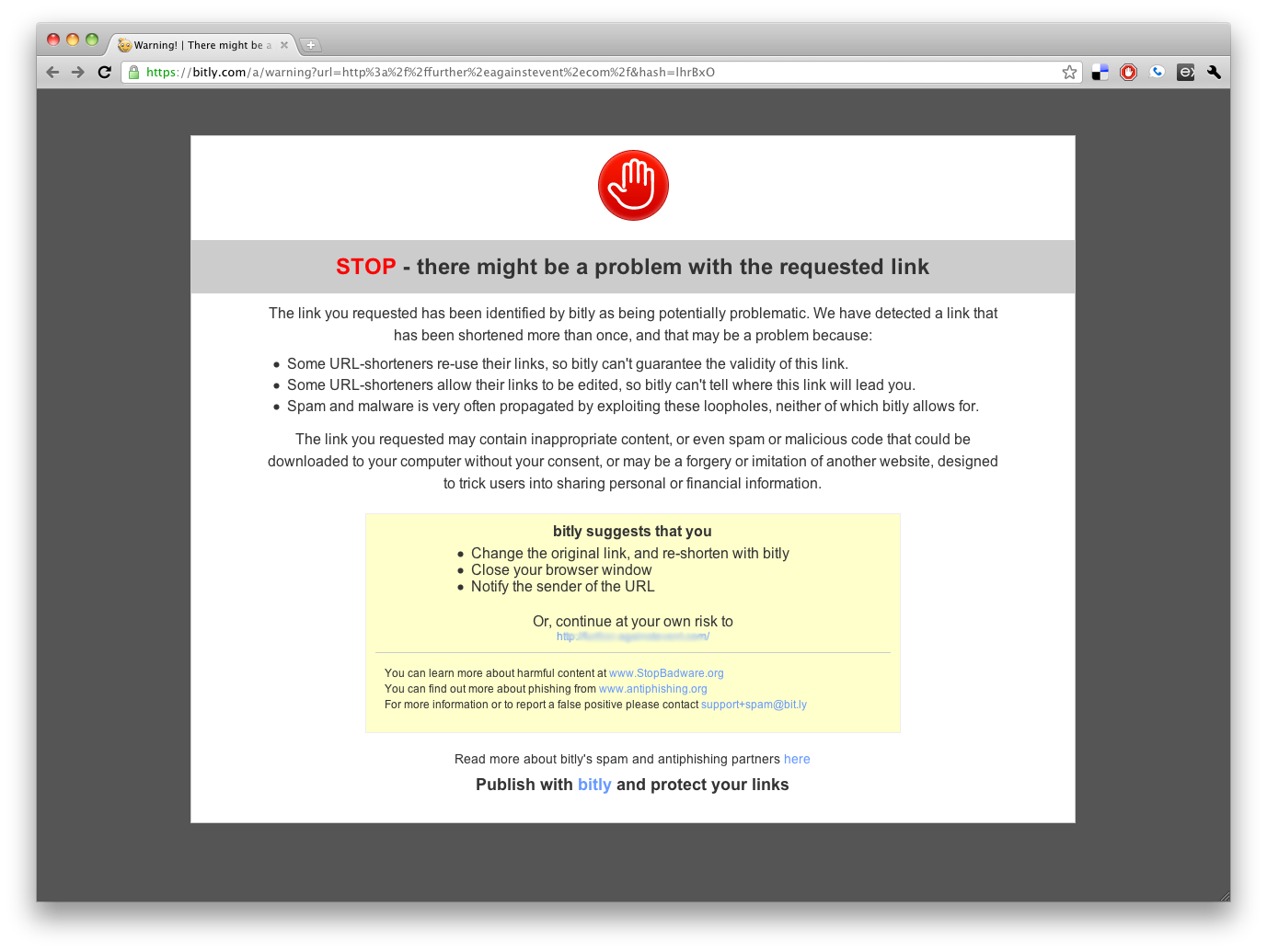
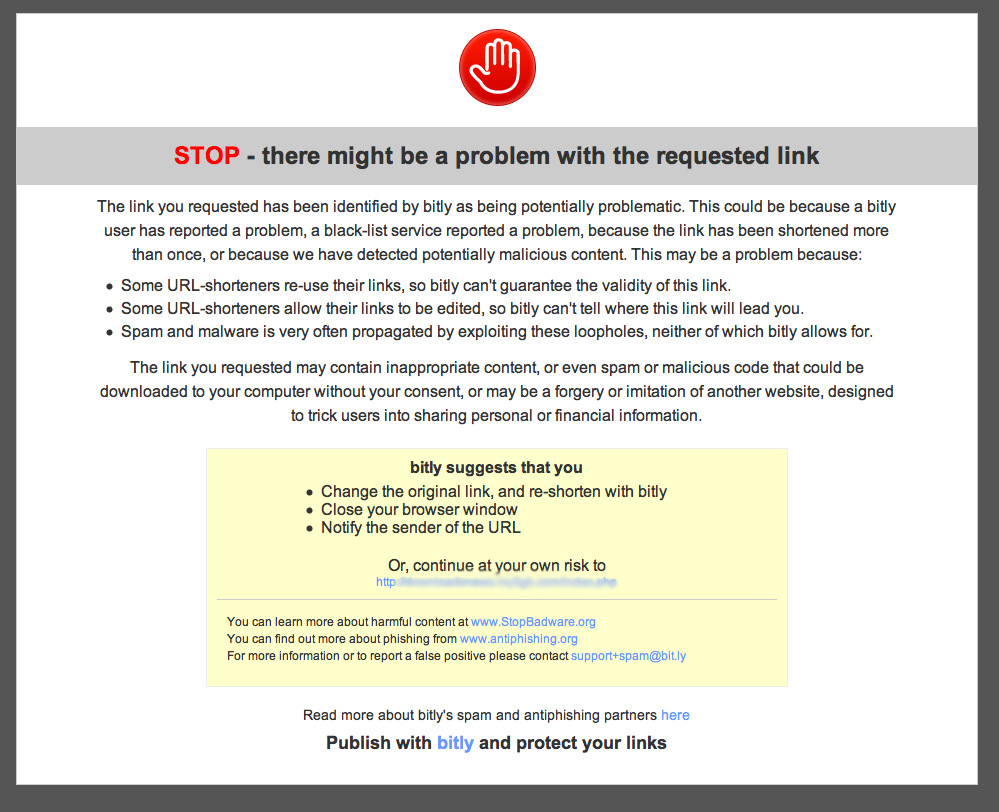
I was interested last week to discover that, unknown to me, the link shortening service bit.ly was displaying a warning message when anyone clicked on one link I had shortened with them. The link was to a controversial but entirely valid political commentary and there had been no indication that this would happen when I shortened the link.  I was even more concerned that the warning message implied I was attempting to hide spam or malware in the link. The message displayed looked like this:

The assertion in the second sentence is completely untrue. The link involved had not been shortened more than once, so the rest of the explanation given there is completely wrong. I got several worried comments from Twitter followers asking what was going on and why I was trying to double-obfuscate links, so I decided to investigate.

Clicking the link myself I started by looking for a way to report a false-positive. (The screenshot above was kindly supplied by bitly’s Chief Scientist, Hilary Mason, after she had quickly updated the last line in the yellow box – prior to that there was no mention anywhere of the possibility of a false positive).  Looking through bitly’s site I found that indeed all the links and pages I could locate were purely for reporting abuse; clearly no-one had anticipated that a mistake might be made.

Buck Passing

I sent a message to their support e-mail address suggesting this was a false positive (possibly created maliciously by a critic of the page I was linking) and to their credit I got a response within a short time. It didn’t help much, though. It said:

Please contact Spamhaus and have the URL removed from their system. We currently have blocked it due to a Spamhaus report. Thanks for asking.

That wasn’t a terribly good answer, for two reasons. First, I checked Spamhaus and there was no indication that the URL in question had been blocked. Second, it’s hardly a job for a user to debug a company’s system like this. I replied asking for clarification and got the reply:

We are Bitly and Spamhaus has it’s own system of how to ask to be removed. They are a spam service that reports a blacklist. I don’t have much knowledge directly of how to get off their list, but I’m sure if you do some research, you can find out quite easily. Thank you.

By this stage I was getting concerned. They seemed to think that they were to free to block any URL without question, and that it was entirely up to me both to detect they were blocking a URL, to diagnose the reason why and to independently go upstream of their filter system and resolve false positives. So I asked for an interview.

Within a few minutes, Hilary Mason called me. We had a good conversation about the spam blocking system she had designed and which bitly have implemented. It uses multiple upstream sources to identify potential abuse, as well as looking for usage patterns that might also be indicative. Unfortunately, despite the fact they have multiple triggers to deciding a link is suspect, they only use a single mechanism to react to the trigger, and it seemed to me that no-one had considered the system from the perspective of a link publisher.

Hilary was also unable to explain why the URL I’d used had been blocked. She did indicate that the URL involved had been on the Spamhaus list in April and that seemed to be the only reason it might have been blocked, but it clearly wasn’t on their list that day, so there’s obviously some engineering work that needs doing. I explained why the text on the alert screen was a problem and she has changed it to the following:
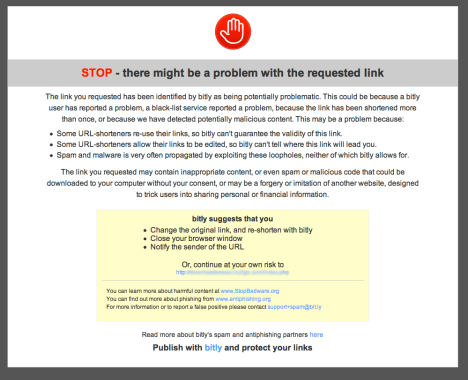
which is a bit less damning of users than the original. But it’s clear that they need to invest time in this to make it more accurate, more informative and to have an actual mechanism for handling false-positives. Hilary explained in e-mail that the original intent had been to have multiple screens depending on the issue that triggered the concern, but that hadn’t made it through to implementation.

Good Approach, Poor UI

All in all, this was a a very unfortunate encounter with what looks like a well-considered approach to handling link-shortener abuse – thanks to Hilary for taking the time to discuss it with me. The fact the alert message includes the option to over-ride bitly’s concerns and just click through to the link is excellent, and an approach that is far preferable to a straightforward blacklist. There’s no doubt that link shorteners offer the potential for abuse and it’s good bitly is taking this seriously.

The fact the system is based on balancing and measuring multiple inputs is also a strength, although  the lack of user feedback to explain the nature of concern is a shame. The fact they don’t alert me, the publisher, to the fact they are going to alert all my readers of a problem is really poor – Hillary assured me that a fix for this is about to be rolled out too. Overall it’s encouraging to see this approach being taken and regrettable the actual implementation doesn’t match the strength of the ideas behind it.

☞ Control Points

  • So Microsoft doesn’t have a patent on XML in document processing in New Zealand. Excellent result for the New Zealand Open Source Society here – congratulations to everyone who has been involved over the long haul involved in the case.
  • While this is a contractual matter at the moment, it’s easy to imagine how HP could make an anti-trust complaint concerning use of market dominance in the software market to attempt to gain control in the hardware market. Presumably Oracle has thought of that and has a defence?
  • So much for “cross-platform”. This is the problem with corporate-controlled platform strategies – arbitrary changes in direction over which you can have no influence can happen at any point to blow you out of the water. Best stick to open standards and community-led activity. HTML 5 anyone?

☝ The FT and the App Trap

I got an e-mail from the Financial Times yesterday, announcing their new “FT App”. That sounded unusual; after all, the FT has had an iPad/iPhone app for some time. I took a look, and found the whole world of mobile publishing waiting for me in microcosm. It’s not open source, but I see the same yearning after freedom driving choices here.

What’s happened is that the FT has scrapped their native Apple app for the iPad and iPhone, and replaced it with a purpose-built HTML 5 web site that can be installed on the iPad home screen as an app. The result looks and feels just like the old native app. It doesn’t work on older devices like the first-generation iPod Touch (the redirect to m.ft.com amusingly says “slow device”), but on the iPad it’s pretty slick.

Why have they done this? Read my view on ComputerWorldUK.

☞ Office Links