☆ Bitly and Spam Links

I was interested last week to discover that, unknown to me, the link shortening service bit.ly was displaying a warning message when anyone clicked on one link I had shortened with them. The link was to a controversial but entirely valid political commentary and there had been no indication that this would happen when I shortened the link.  I was even more concerned that the warning message implied I was attempting to hide spam or malware in the link. The message displayed looked like this:
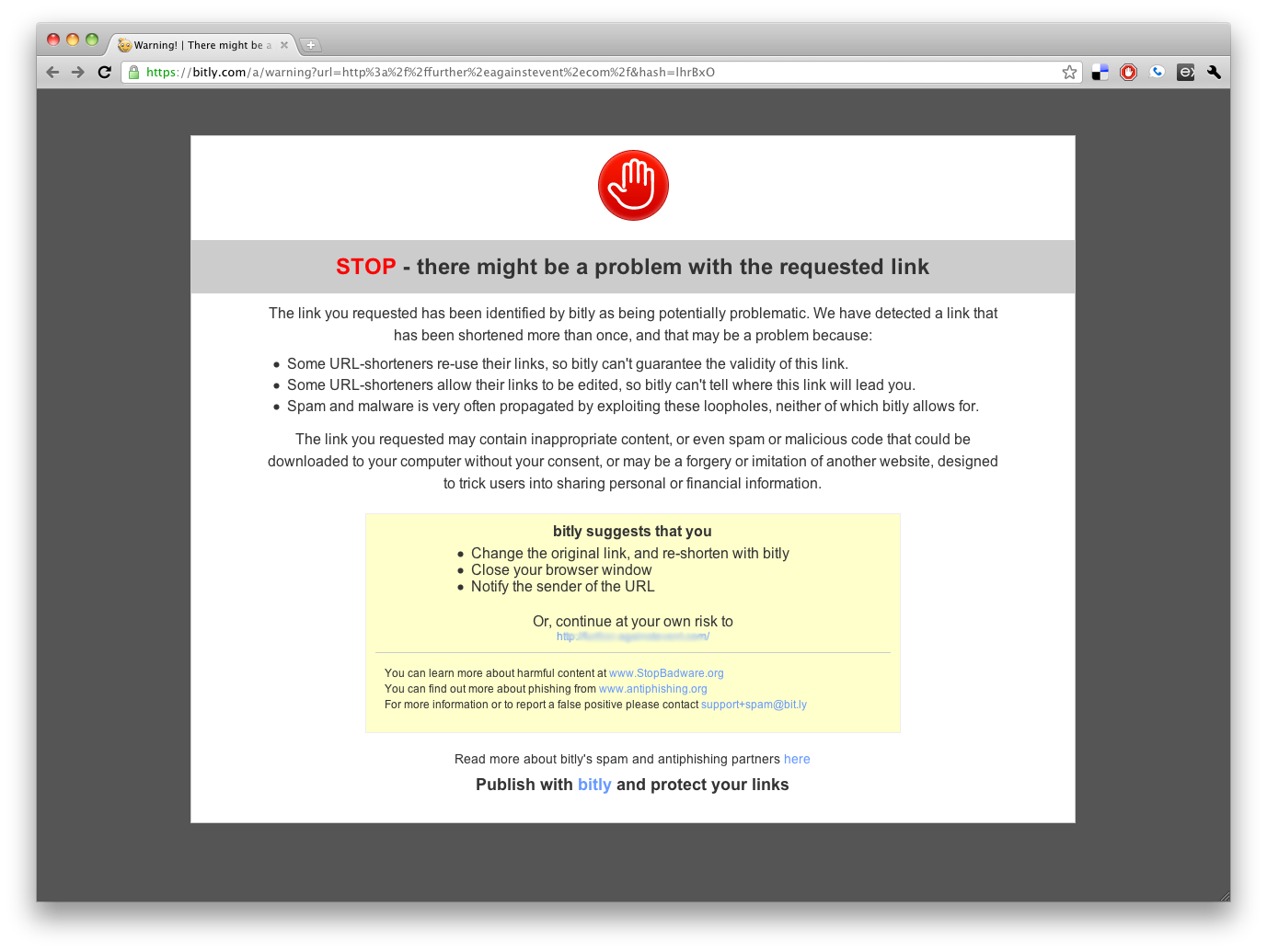
The assertion in the second sentence is completely untrue. The link involved had not been shortened more than once, so the rest of the explanation given there is completely wrong. I got several worried comments from Twitter followers asking what was going on and why I was trying to double-obfuscate links, so I decided to investigate.

Clicking the link myself I started by looking for a way to report a false-positive. (The screenshot above was kindly supplied by bitly’s Chief Scientist, Hilary Mason, after she had quickly updated the last line in the yellow box – prior to that there was no mention anywhere of the possibility of a false positive).  Looking through bitly’s site I found that indeed all the links and pages I could locate were purely for reporting abuse; clearly no-one had anticipated that a mistake might be made.

Buck Passing

I sent a message to their support e-mail address suggesting this was a false positive (possibly created maliciously by a critic of the page I was linking) and to their credit I got a response within a short time. It didn’t help much, though. It said:

Please contact Spamhaus and have the URL removed from their system. We currently have blocked it due to a Spamhaus report. Thanks for asking.

That wasn’t a terribly good answer, for two reasons. First, I checked Spamhaus and there was no indication that the URL in question had been blocked. Second, it’s hardly a job for a user to debug a company’s system like this. I replied asking for clarification and got the reply:

We are Bitly and Spamhaus has it’s own system of how to ask to be removed. They are a spam service that reports a blacklist. I don’t have much knowledge directly of how to get off their list, but I’m sure if you do some research, you can find out quite easily. Thank you.

By this stage I was getting concerned. They seemed to think that they were to free to block any URL without question, and that it was entirely up to me both to detect they were blocking a URL, to diagnose the reason why and to independently go upstream of their filter system and resolve false positives. So I asked for an interview.

Within a few minutes, Hilary Mason called me. We had a good conversation about the spam blocking system she had designed and which bitly have implemented. It uses multiple upstream sources to identify potential abuse, as well as looking for usage patterns that might also be indicative. Unfortunately, despite the fact they have multiple triggers to deciding a link is suspect, they only use a single mechanism to react to the trigger, and it seemed to me that no-one had considered the system from the perspective of a link publisher.

Hilary was also unable to explain why the URL I’d used had been blocked. She did indicate that the URL involved had been on the Spamhaus list in April and that seemed to be the only reason it might have been blocked, but it clearly wasn’t on their list that day, so there’s obviously some engineering work that needs doing. I explained why the text on the alert screen was a problem and she has changed it to the following:
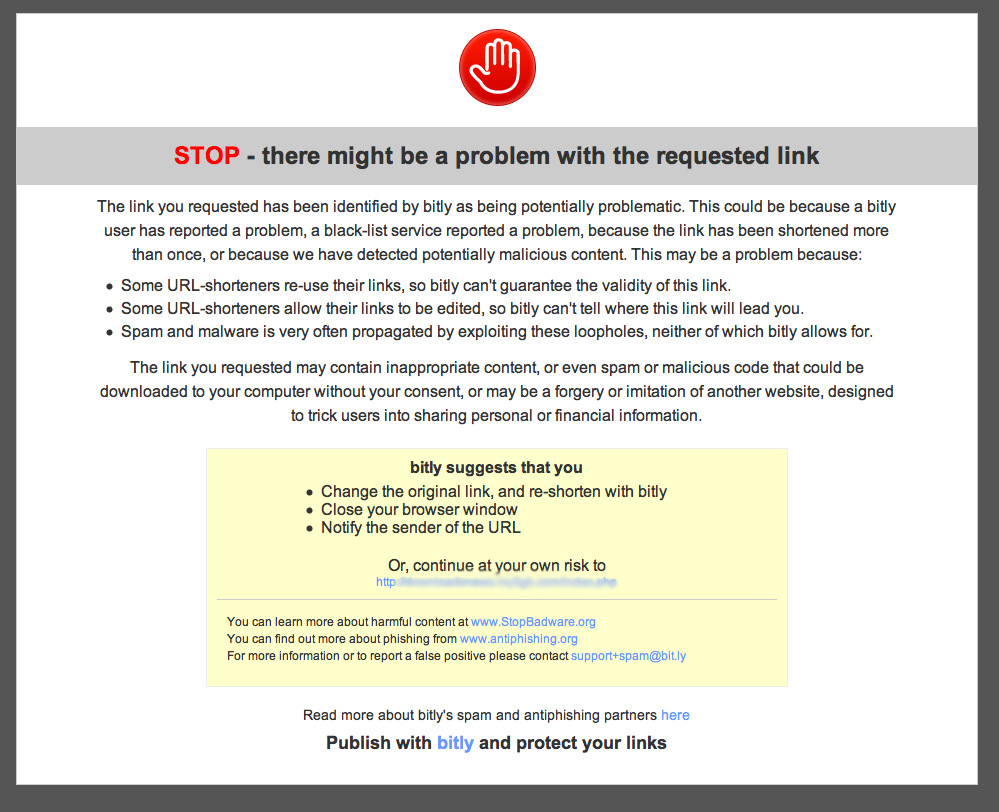
which is a bit less damning of users than the original. But it’s clear that they need to invest time in this to make it more accurate, more informative and to have an actual mechanism for handling false-positives. Hilary explained in e-mail that the original intent had been to have multiple screens depending on the issue that triggered the concern, but that hadn’t made it through to implementation.

Good Approach, Poor UI

All in all, this was a a very unfortunate encounter with what looks like a well-considered approach to handling link-shortener abuse – thanks to Hilary for taking the time to discuss it with me. The fact the alert message includes the option to over-ride bitly’s concerns and just click through to the link is excellent, and an approach that is far preferable to a straightforward blacklist. There’s no doubt that link shorteners offer the potential for abuse and it’s good bitly is taking this seriously.

The fact the system is based on balancing and measuring multiple inputs is also a strength, although  the lack of user feedback to explain the nature of concern is a shame. The fact they don’t alert me, the publisher, to the fact they are going to alert all my readers of a problem is really poor – Hillary assured me that a fix for this is about to be rolled out too. Overall it’s encouraging to see this approach being taken and regrettable the actual implementation doesn’t match the strength of the ideas behind it.

☞ Control Points

  • So Microsoft doesn’t have a patent on XML in document processing in New Zealand. Excellent result for the New Zealand Open Source Society here – congratulations to everyone who has been involved over the long haul involved in the case.
  • While this is a contractual matter at the moment, it’s easy to imagine how HP could make an anti-trust complaint concerning use of market dominance in the software market to attempt to gain control in the hardware market. Presumably Oracle has thought of that and has a defence?
  • So much for “cross-platform”. This is the problem with corporate-controlled platform strategies – arbitrary changes in direction over which you can have no influence can happen at any point to blow you out of the water. Best stick to open standards and community-led activity. HTML 5 anyone?

☝ The FT and the App Trap

I got an e-mail from the Financial Times yesterday, announcing their new “FT App”. That sounded unusual; after all, the FT has had an iPad/iPhone app for some time. I took a look, and found the whole world of mobile publishing waiting for me in microcosm. It’s not open source, but I see the same yearning after freedom driving choices here.

What’s happened is that the FT has scrapped their native Apple app for the iPad and iPhone, and replaced it with a purpose-built HTML 5 web site that can be installed on the iPad home screen as an app. The result looks and feels just like the old native app. It doesn’t work on older devices like the first-generation iPod Touch (the redirect to m.ft.com amusingly says “slow device”), but on the iPad it’s pretty slick.

Why have they done this? Read my view on ComputerWorldUK.

☞ Office Links

☝ OpenOffice.Org and the LibreOffice Imperative

As expected, the Apache Software Foundation took the first steps to admitting the OpenOffice.org project to the Apache community, following Oracle’s IBM-designed proposal. It now faces a time of maturing and proving in Apache’s Incubator.

I’ve avoided publishing articles here during the Apache discussion as I have both a history and strong views. But with the end of voting, it’s time to document the story so far. You can read my views over on ComputerWorldUK.

If that’s TL;DR, here’s a summary:  The best thing end-users can do is ignore OpenOffice.org at Apache, and switch to LibreOffice instead until the dust settles and we can all see a better path forward.

☆ New Cat

It was with huge sadness that we discovered last month that our cat Toby had died suddenly in a neighbour’s garden. He was young and in perfect condition. He had breakfast, went out to prowl in the sunshine and the next thing we knew was many hours later when we received a call to say he’d been found, perfect, unmarked and dead. The vet said it was most likely a blood clot which had stopped his heart.

That sadness is mitigated by the arrival of a new member of our family today. Our usual cat-provider-of-choice, the Cats Protection League, had a one-year-old stray on their books, and we collected her this evening. T S Eliot-inspired cat-naming is now in full swing. I expect her to be faster and more reliable than any of her predecessors – she is, after all, Cat 6.

☆ British BBQ

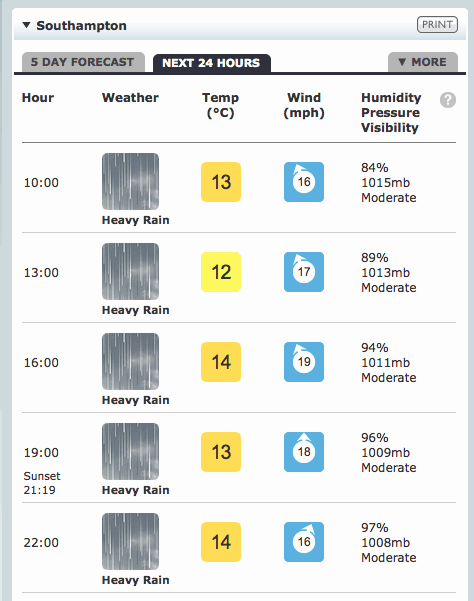
Ever wondered why barbecues aren’t the staple of summer life for the British that they are for Californians? It’s because any time you try to plan one (like we have today, with a decent number of guests), the weather does this:

(Rain)

☞ Apache Edition

  • Vote on accepting OpenOffice.org for incubation at Apache
    After the heaviest traffic in recent memory on the Apache Incubator list, with many impassioned messages on both sides of the argument (along with some heavy-handed slapdowns here and there by proposers of the action), the vote is now open for 72 hours and looks like it will gain approval by a comfortable majority.
  • My +1 Vote
    I voted in favour of starting an incubator podling. I did this because I believe there is a strong future for a new project drawing code from OpenOffice.org and maintaining it for use by multiple projects, such as LibreOffice, RedOffice and Symphony. I believe it would be hard and misdirected work to attempt to build a full competitor to any one of those projects at Apache – a good explanation is on the mailing list.

    If a re-usable reference implementation of ODF editors for each ODF sub-format can be created from the code Oracle is relicensing and maintained at Apache, it could be immeasurably positive for everyone. Over time I’d hope LibreOffice, Symphony and the rest could incorporate that new work, since the strongest path to interoperability by way of a clear and open specification with a shared open source reference implementation. 

    If on the other hand the Apache podling just turns into an opportunity for the known opponents of LibreOffice to attempt to compete with it using the “OpenOffice.org” name, that will be a dark development for software freedom and I’ve expressed my disapproval strongly elsewhere.

  • An Invitation to Apache OpenOffice
    While the official statement on IBM’s behalf is interesting, the discussion in the comments is far more enlightening. The statement itself completely ignores the existing ecosystem and speaks as if Apache is moving into a green field, but the comments reveal how the existing community feels about that as well as showing the intense and inexplicable antipathy IBM feels towards The Document Foundation in general and LibreOffice in particular.  Note especially the wise and balanced comments from Jeremy Allison (of the Samba project).
  • The FSF’s statement is pretty balanced. I can’t help thinking they were forced to comment after misinterpretations of their advice on licensing were forcefully asserted by the proposers of the Apache podling despite correction from an FSF Board member.

☞ Slow Progress To Modern Business

  • My own conversations of late suggest that wiser minds (or rather, minds that can make the reptile see the difference between food and fear) are starting to prevail in the various publishing industries, and the tone is softening as business models that leverage the realities of the 21st century instead of fighting them start to succeed.
  • This is bad news, but given the shift to the right that’s happened in SCOTUS not terribly surprising. Let’s hope that Congress sees the case and realises that the law needs updating, as appears to have happened in the UK given the request for and then result of the Hargreaves report.

☞ The Way VCs Think

  • One of the things I keep hearing some advisors saying is that VCs won’t invest in your startup (or at least are much less likely to) if you don’t have any patents, becuase patents protect your innovation. In turn, this meme is used by patent capitalists (like disaster capitalists only more active) to justify their assertion that patents promote innovation. Well, here’s one of the most respected VCs I know saying that’s just not so.
  • Looks like Scott is about to get back into directly running a business again. Wonderful!
  • For those random text applications, try something a little meatier next time.